Showing posts with label writing tips. Show all posts

Friday, August 31, 2012

Freaky Friday ~ When You Run Out of Gas


Well, not gas, exactly. But you know when the ideas just stop coming, as in writing, that is.


Although I'm prolific, and have notebook filled with ideas for stories, and have the muse wake me at odd hours of the night with the idea I need, I do, from time to time come to a stand still and ask "Okay. Now what?"


I had that happen the other night. Well I thought, why not ask a question. Not "What's next", but a question that might spark an idea.


A quick scene here. Set up: Sabrina is to donate her plasma at a place that collects it. She's waiting to be called back...


“Are you guys going to be able to go in with me?” I asked.


Rick made a shrug. “Probably not,” he said. “Some places don't allow anyone back there but the donor.” He looked down at his iPhone and then up, and something caught his eye. “Kiel,” he said almost under his breath.


I looked across the room and saw a woman in a green smock enter the room and then immediately turn away and dart back through the doorway.


“Kiel? Hey, Kiel!” Rick shouted. “Aw, crap.” I watched his face as it went through a couple of quick emotions, the first one was surprise, the next one was something like suspicion, and the third looked like worry.


“What is it?” I asked. “Who was that woman?”


“That was Kiel,” Rick said and blew out through his nose like a bull about to charge. He turned back to his iPhone and tapped some message on it rather vigorously. “This is fucked!”


“What? Why?” I said, exchanging glances with Cho.


“Kiel is a witch,” he said as he tapped something out onto his iPhone. “She's also my ex, but that probably has nothing to do with it.” He stopped and looked up. “At least I hope not.” He resumed his tapping. “Christ!”


“Should I go after her?” Cho offered.


Rick looked up. “Knock yourself out.”


Cho jumped up and sprinted through the room and disappeared through the doorway, almost barreling into someone else coming out. I watched a woman shuffled through looking back at where Cho had gone as if trying to understand what was going on. Shaking her head, she went up to the desk.


Some how I had to bring things together here and explain who the mysterious woman was who appeared in a doorway and then disappeared. And Rick, the leprechaun, happened to recognize her.


What I needed was to explore Rick's past a little bit as well. Nothing worse than not giving your secondary characters a background. They need some story from the past to deepen their characters.


So, my question was: What if Sabrina finds something the witch had on her?


Okay, but what? And why/how would it be used?


I came up with the idea of jewelry. Nothing more personal than that and an earring could easily be lost in a chase. So, the earring was found.


I wanted Sabrina to try and get a "read" from it (she is a psychic). But then I thought, if I spoil things here as to what's going on, then I've spilled the beans. So, I have it that she can't read the object. Obviously the witch put a spell on it. But I went on and gave a little background on Rick:


“Come in. I'm alone,” I said.


They came in and shut the door.


“What's up?”


I held out the earring to Rick. “Look familiar?” I saw Cho eyeing it and lifted for him to look at.


“She was wearing earrings like that,” Cho said.


“Yeah,” Rick said, plucking the earring from my fingers. “Those are like what she'd wear.” He looked up. “Where did you find it?”


“Actually Ariel found it on the floor, in here.” I lifted my eyes to Cho. “What happened to you? Did you loose her?”


“I did,” he said. “Once I left the room, it was as though she had vanished.”


“She can travel the ley lines. There's a pretty good one here,” Rick said.


“I must have been too nervous to notice,” I said, shivering. “Now I'm just cold.”


“The blood leaving you does that,” Rick said. “You're lucky that Ariel came to do this. She's pretty good.”


“Rick. You said we were screwed. Why? Because of Kiel being here?” I asked.


He hedged. “Maybe. Like I said. I don't know why she was here.”


“Let's find out,” I suggested.


Cho and Rick exchanged glances.


“How?” Rick asked.


“Here.” I handed him the earring. He took it. I then held my hand toward Cho. “Take the glove off my hand.” He did as I asked. “Now, Rick, place the earring in my hand. I may go into a swoon, but I'm sitting and have nothing better to do.”


“We'll stand guard,” Rick said and carefully settled the piece of jewelry in my hand. My skin tingled, and then heat radiated from the object. I pulled in a surprised breath. After a moment, the tingling dissipated.


“You okay, Brie?” Rick asked, his hand hovering over my hand.


I swallowed, looking into his brown eyes. I waited. “I'm getting nothing.”


“It might be charmed,” Rick said.


“Okay. Just take it away.”


Rick took the earring out of my hand.


We were quiet for a few heartbeats. Then I had to ask.


“Okay, what do you know about this witch?”


“Kiel Saint Thomas is no saint by any means,” Rick said. “I knew her about five years ago. We dated.” His eyes slid back to Cho, then on me. “I thought things were going great. And then I realized she was using me to learn... things.”


“Learn things?” I said. “Like what?”


“Well, ley line travel, for one.”


“You knew she was a witch?”


“I knew it the moment we met.”


“Where did you meet?” Cho asked.


“In a club on the north side.”


“Really?” I said.


“And we sort of hit it off.” He beamed and slid his eyes again to Cho. “The sex was fabulous.”


Cho and I wisely kept silent.


“She'd have me help her in spells,” he said slowly, looking down. “I didn't like what those spells were for.”


“Why? What were they for?”


“She was trying to raise the dead.”


“Oh, come on!” I said.


“No. It's been done by famous witches like John Dee. But then she asked if I knew any vampires. You know, personally?”


“And you probably did,” I supplied.


“I did. But I was getting some bad vibes off of her and where she wanted to go with her witchcraft. I thought it was turning into more black. She wanted to go after certain people who had wronged her, that sort of thing.”


“Yes. Definitely black magic,” I said.


“So, I hesitated in introducing her to any vampires. But it doesn't take much to find one, especially if you're a witch.” He shrugged. “Anyway, I broke it off. I had to have another witch put a protection spell on me so that she couldn't hex me.”


I nodded. “So, Kiel probably has found a couple of vampires by now.”


“No doubt.”


“Rick, I'm not sure what level Kiel is at, but if she's in with the wrong vampires...”


“You mean the likes of Ilona and Nicolas?” he suggested.


I slid him a look. “The very same ones. She may have been in cahoots with them to find me and do something to prevent me from giving blood.”


“Most likely,” Cho piped in, “she was here to take your donation and not get it to Tremayne so that he would die.”


“Ahhh,” Rick said. “That would be just her style, too.”


“No doubt Cho is right.” I sat for a moment thinking, shivering again. My coat had slipped off me some. Cho moved it up and arranged it around my shoulders. “Thanks.” I held the coat in place with my free hand. “I'm wondering if I were to take that to another witch what she might learn from it, if anything?”


“I don't know,” Rick said, holding the piece of jewelry between his thumb and first finger to let it dangle. Overhead lighting shown through the amber beads. “Worth a try, I guess.”


The question worked. I knew that if Rick knew her there had to be some background. The link was the earring.


Next time you have come to a stand still ask a question. Or many. Keep asking them until you hit on the right question that gets your brain working on the story.

Wednesday, January 5, 2011

Middles - Of Stories, that is . . . And Endings of my three weeks off


Hey! We got through the holidays! My husband and I got through the lay-off okay. Every cent going to bills with a little bit left over--in case of over-drafts. The good news is we won't be put out on the street. Yeay!

My three weeks off allowed me to work on my books--both second and third--and toward promoting the first one. I'm told it will be on Amazon Kindle soon. Probably the end of this week, in fact. So, all you Kindle people, get ready.

It's amazing what one can do when they have the time to do it. I'd love to do this for the rest of my life if only I could make money at it. But, hey, I keep on getting mailings from Publisher's Clearing House, so you never know. Right?

To the middle part of my post.

Everyone of you writers out there knows that the middle of your books could have the potential to sag if you don't do something exciting to keep things going. You need the Idea Train to be fed. (Idea Train is my word for it, I don't know what any of you like to call it, but I call it a train because once that train begins to move, it chugs along up and down mountains, no matter what.) If we relax our mind, not worry about finding that one or two things that would shock, or make the middle exciting, then, when you least expect it, it will happen. Like I've posted before, it's like a bolt of lightning when it hits.

When I'm writing, this is how it works. I write as much as I know--like driving at night with the lights on, you see only so far ahead. When I get what I can down, I quit. I may make notes because there are tidbits there, I just don't know how to connect them.

Usually while in the bath/shower--and some of you know that's when things hit you--or during the night, the idea will jell and solidify and become the full, or at least a portion of an idea. That's the exciting part of being a writer, when this happens.

And this is where I am, at this point with the third novel. Dark, scary things happen, and just when you allow your readers to relax, you spring a whopper on them.

Yesterday I wrote two new chapters. Nearly 4,000 words, but not quite. And later on, I went to my notes for the book and wrote some things down and this morning POW, BAM, WHAM! It was there.

All things must come to an end.
Not that I'm thinking too much about going back to work, but it's a niggling thought, I even had a dream about my boss last night--oooo, I hate those--even though I like my boss. But I'm capping off my 3 weeks in a wonderful way, I couldn't have planned it better--but actually I did!

My book signing is this coming Saturday. I'm looking forward to it. I'll be popping into the bookstore to make sure the books are in (if they're not we're gonna have problems selling no books!)

Its a good idea to go and get to know your book sellers, the people in the bookstore are there to help you, because you are there to sell some books--hopefully a LOT of them. So, if you do get a book signing, it's a good idea to go to the store, get to know the manager and people who work there. It's sort of nice to be treated like a celebrity. Because you are.

And, last but not least, my friend Jen Jackson, has agreed to post an interview on her post. I will make a separate post announcing it on Friday, when she has it up, and give her link on it then.

Monday, November 29, 2010

WORDSMITHING 101 - Part Five: Problem Solved

I'd been trying to figure out a segment of my book for a few weeks, and the moment for when I would have to confront it was last night. I'd gotten so far and, since it was time to go to bed, anyway, I simply stopped there.

My character is a clairvoyant, but she's also becoming more magical as the days go by (or as the series progress), because she is also a sibyl. As a sibyl she is able to see things that others cannot. She also now possesses a very, very old dagger which had belonged to the last sibyl, and has been handed down to her. She really doesn't know how she will use it, but she has a terrible feeling she's supposed to be killing undesirables with it.

In my third book Sabrina is in another world where vampires actually run it, and humans are nothing more than walking blood banks, and for sexual gratification. Oh, and vampires are viable here, thus we have half-vampire, half-humans walking about.

But other things, darker things, roam this place, and although the humans can't see them, Sabrina can—and so can vampires and the half-breeds. These beings are cloaked from head to foot, and normally simply stand in a corner doing nothing.

My actual first idea was to have them interact with humans, or the vampires, and then I decided not to.

Jett is one of the half-breeds that Sabrina gets to know, his mother is very sick, and they go to her bedside, and low and behold, here stands one of these black-cloaked individuals. Sabrina sees it; she's seen them before and so simply presumes they are hanging around for some reason. She senses nothing from them at all.

Then the dagger, which she has strapped to her leg, flies out of the sheath and kills the being, and it collapses, the body disintegrates.

This scene was going through my head last night as I went to bed. I knew now why this woman--Jett's mother--was sick. As the creature dies, the woman suddenly opens her eyes and begins to gradually feel better.

Prior to this I knew I wanted Jett's mother to be sick, and I was trying to figure out what she was sick from. Something they couldn't cure on their world, of course. But I could come up with nothing. For weeks I'd been pondering this question. And then, last night it simply came to me.

These cloaked creatures create sorrow, depression, sickness, wherever they go. And they will remain wherever they find someone weak enough to infect.

Sabrina's knife, obviously, is able to kill such beings, because it's magical. She and Jett are both startled by this outcome. The fact that she can see them is also startling. Jett tells her no one has ever killed one before, and that they can't ever get rid of them. Usually once one has infested a family, it's not uncommon for the family to die, one by one.

Solving this problem I can now move on. I knew, eventually, the answer would come to me. Pondering it, but not worrying about it was the key. When I went to bed, my mind was going into a restful state. I used to be amazed by this ability to find an answer to some plot problem, or story situation that needed to be written and I had no idea what I would do. Seems that whenever I come to that point of writing it, it usually works itself out. As though the answer was just laying within reach. Just underneath the surface.

I think of my finding such solutions like an archaeologist may uncover some treasure. Even as the solution might be elusive at first, dogged determination, and following leads, soon you unearth this treasure and maybe more to follow. And soon you'll have a string of discoveries, and they all fit together like a large puzzle.

The life of a writer is that of solitude as we work. But in that solitude comes wonderful discovery of who we are. We become amazed at how our talent grows over time, and the workings of how we solve these little writing problems seems to become part of the process. If we don't push a panic button, learn to relax our mind, the answer eventually comes along.

Discovery of the very depths of our imagination is part of who and what we are: Writers.

Saturday, October 23, 2010

When Lightning Strikes--WRITE IT DOWN!


It has been a month, or so, since I had written those few chapters that would become my third vampire novel/series. Life's dramatic episodes just took precedence, and it was tough for me to get back to this. Plus, I've been working six days a week. It was difficult to reacquaint myself with the story, and the plot idea.

My problem was I hadn't had a chance to think it through. I didn't even have a clear idea who my villain was, nor why things were going on the way I'd had them.

Rule of thumb when a story just isn't jelling for some reason: Wait it out.

The waiting is worth it. Other things in life might help bring things into a certain light that you at first hadn't thought about before. Once I allowed my mind to not worry about this story, it relaxed enough so that I was able to do this question and answer series of why this and what if game. You need to question the why part, and then ask what if mainly because the what if's pile up and you suddenly have inspiration for some better plot line, something that hadn't occurred to you before, when you began. This is why there is a first draft. Every writer worth their salt knows that it is going to change drastically. I think when we write something down, we do merely because it does feel like a good start. And there's probably some good stuff in there that in a second draft could stay, but you change it around to go with the new ideas.

I sometimes take from real life. But most writers do. We watch the news, read articles in newspapers. Many horror fiction writers take from real life and tweak it, sometimes a lot.

In my area right now a college student has gone missing for more than a week. It's a terrible tragedy. I'm trying to put myself in the place of the parents, or someone--like a sister--close to her. My heart-felt wishes for her to be found safe.

Taking from such a tragedy makes me feel a little guilty because it is still on going. The weird twist to this story is that another man--I think he might have been in construction--disappeared in the same general area about 5 years ago. Never seen. However this isn't related.

But my mind is doing the "what if" thing. Since I deal in urban fantasy, my what if is what if the missing people came across a portal that took them to another place/another world plane? My heroine, being a clairvoyant, is asked to look for the sister of her brother's wife. She stumbles across that same area, that same portal.

In reference to such things, I looked up black holes, looked up the Theory of Relativity, to help base my story on these ideas loosely. There was a picture in a book I had that showed black holes, and lines going from one black hole to the other and it suggests that these networks might allow objects to travel through time and space--according to some scientists. Another thought I gleaned from this article was that objects that go into black holes may re-emerge elsewhere . . . and elsewhen. Then it goes into the idea that UFOs are actually visitors from a parallel reality, or from another dimension.

So, my gentle readers and fellow writers, when looking for something to spark your imagination, open up a good book (Mine happened to be Into the Unknown by Reader's Digest, copyright 1981), and articles in the newspaper. I save a lot of articles in a big bin and look through them once in a while.

When lightning strikes, you'd better have your notebook and pen at the ready, just in case.

Monday, October 11, 2010

WORDSMITHING 101 ~ Part Four: Plot

You know what it's like when you have a great idea for a new book. It's exciting! You have a scene, characters, some dialogue. You can't wait, and have to begin writing, because all this stuff is inside you. You want to see it come alive on the page.
So, you get a chapter down. You have a few more characters to add. Scene upon scene evolves. Then, before you know it, you have another chapter, and things are beginning to take shape, and you think this might just work. And then you get a few more chapters and you come to a screeching halt because you have hit a wall.
I'm sure I'm not the only one who has done this. I get into writing a new book, and the it's like being inside a corn maze. I don't know which way I'm going once I get inside, and sometimes, I come to a dead end and have to go back!
You're asking yourself: What do I want to happen, and what do I need to do to get from one end of this story to the very end? How can I write all that—60K to 80K words, or more—and come up with all the middle stuff and make it all work toward a climax, and then that good ending I know I want to write?
Well, plotting. Of course!
But HOW do you plot a whole book?
Good question.
When I first started out—this was back in high school and college—I just kept on writing and writing. My novels just were going on and on. Maybe there were some high climax parts, romance, etc. But I know I had no idea about plot. I call these my beginner novels. Practice. Boy, did I do a lot of practicing.
The plot of a book is much different from a short story. You have all these sub-plots going, maybe a romantic sub-plot (sometimes called threads), too. How do you mix it all in there and keep the story knitted together? You have to consider the genre as well, because some restrict you from doing certain things. That's why I like urban fantasy. I can do it my way, pretty much.
The basic plot is like a weird looking M with an extension (I had a drawing, but it didn't go through, unfortunately)
Your beginning (first ¼ of the book), should introduce characters and a situation, which is compelling enough, that it will carry your story to the end. You want to start out with some excitement, of course, start out with a bang, but it can't out shoot the climax, because it's up there (notice that the climax is at the very top. Think of these peeks in the plot as you would a mountain range with peeks and valleys. The highest peek is your climax. You need to begin to build tension, holding the reader with all the threads up until the climax, you may have several threads, but not too many for your reader—or you—to keep up with.
Your hero may have to try and resolve a big problem almost right away, complications set in—your character is drawn off what they need to do to take care of this other thing, which seems insurmountable, and your readers have to be allowed to pause and wonder how she will get out of this, or what she will do.
This is called a cliffhanger. To create a cliffhanger you need to ask yourself what is the worst thing that could happen here? And have some way of resolving it, but not let your readers see how, and yet do so believably. Conflict isn't easy to put on your characters, the ones you really like, but you need to do it to keep the tension tight, and to show how your character reacts, and changes, or grows, emotionally because of it.
The middle of the book needs to have more cliffhangers, and tension in order to keep the reader interested. If there is a romantic thread, milk it until there is no way to keep the two apart (Michelle Hauf and Jeaniene Frost authors of romance/paranormal romance). If the romance is not an important equation to your novel—just a side dish—you need to bring in something that fits your genre, like a mystery writer needs to build up to her climax (Janet Evanovich). But you don't want to let your readers down in the middle either. So what do you do? What you want is to bring in some dark moment. A different mystery or problem that your character has to solve (J.K. Rowling). But even once she/he solves it—if she solves it—she finds that either doing so creates more problems, or something else happens as a result (Charlaine Harris).
Brainstorm the cliffhangers first, see if they'll work. If they don't you'll think of a better one, I assure you. Keep a notebook handy, by the bed, or somewhere you know you can get to it in the middle of the night—because believe me, as soon as your mind relaxes, you turn out the light, that's when inspiration kicks in.
And notice that the resolution is not very long. One to two chapters at the most, or have a epilogue. Your climax has happened, and now you need to have the bad guy pay, or in some cases, get away, but thwarted, and the rest of your characters lick their wounds and tie up loose ends.
To help you plot your story:
On a piece of large paper—if you can get a roll of newsprint, that is best—draw the plot line in a thick marker and then either write on this paper, or on separate note cards, all the different scenes you have in mind and either pin or tacky-glue them to areas along the plot lines. This will help you see where you are going with your plot. I'm a visual person and have made this plot line permanently on a large sheet of heavy newsprint I got from a printing company, and tacked it onto a large sheet of blue insulating board—tacks go in easily.
If you need more help with plotting I highly recommend “Plot Whisperer” http://plotwhisperer.blogspot.com Her site is devoted primarily on plotting the novel. She even has informative videos, and eBooks, etc. that you can find through her site.

Monday, October 4, 2010

WORDSMITHING 101 ~ Part Three: Dialogue

Today's entry in WORDSMIGHING 101 is, Dialogue  Their Mechanics.
I thought I would set things up with something from deep within my own book, Vampire Ascending:

“I spoke to Nicolas,” Tremayne informed, coming out of his distracted expression.

“Yes?” I reached for the water glass, took a couple of sips from it, wishing it was a glass of wine.

“They finished questioning the woman. Her name was Solange, just as you'd said. She's from L.A., and, as you so brilliantly detected with your powers, is a shiftchanger. She changed into a cat to gain entrance into the garage.”

I nodded. Swallowing, I replaced my glass on the table. “What about the bag?”

“Leif and Darla have gone down to find it.” He went on swiftly, “She wasn't aiming for Heath, by the way. She was aiming for you.”

Shocked, I stared at him open-mouthed. “What? Me?”

Tremayne drummed the fingers of his free hand on the armrest. “Yes. My educated guess is that our killer knows about you, and wants you out of the way. You are the only one who can identify him, with your clairvoyant powers.” He shifted in his chair, staring intently at me. “I've been informed she was bitten. My guess is a rogue vampire is behind this.” His gaze went off me, looking pensive.

“But I thought we agreed that the killer was human.”

“The one who shot Letitia, yes. But the master-mind behind this must be a vampire. A human can't be hypnotized to the point of killing another person, unless they were already a killer, so she was enthralled by a vampire. We've identified our little shiftchanger as Solange LaPrima. She's from L.A., and that's all we got from her.”

“But you're saying a vampire bit her and sent her here?”

“Yes, sent her here to find and shoot you.” He squeezed his eyes. “I don't like that they knew where to wait for you. Or what you liked like.”
Me either. Where was that wine?strong>
©2010 Lorelei Bell

If you will note the dialogue moves along well, and we learn about something that concerns both speakers. You will also note that between the dialogue the two are doing something. These are called beats. The places where you identify who is speaking (he said/she said) are called speaker attributes. Also there is one instance of what is called interior monologue, at the end of this section.

Before I even go on, I have to make an admission. Not long ago I actually didn't know the mechanics of dialogue at all. I was doing it all wrong. Funny, people who read my material, never made note of it. Let me show you an example of what I was doing, and see if you catch it.

“I spoke to Nicolas.” Tremayne informed. . . .

It is quite subtle. But if you look closely at the punctuation, you'll see it. I'll make it easier:

“I spoke to Nicolas.” He said.

Now do you see it? There needs to be a comma after Nicolas, and before the quotation marks. Plus, He said, shouldn't be capitalized. I made this mistake, thinking I was doing it right.

How embarrassing! I was sending my books out with dialogue like this. The most aggravating thing about it is, I had written a novel and sent it off to a romance publisher, now more than a dozen years ago, and they were slightly interested, but said that there was a problem with the dialogue. Well, they didn't tell me what exactly. I didn't know what they'd meant. Had I known my mistake, maybe, just maybe, I would have had a first novel published back then.

I sort of stumbled upon my error when I decided to pay more attention to how books were written. Remember in my last post in this series I said to write down whole sentences of writers you like and examine how they write? I mean really pick it apart from word usage, to how they set up the whole thing, and right down to the mechanics of it.

Dialogue in a work of fiction is there to help you build characters, create tension between them, to inform the reader of certain details, and move the story along. In the above example, my main character—Sabrina—is given information in doses. By not having Tremayne go on and on in a long paragraph (which can get boring), I feed it to her—and to my readers--in sections. To break it all up, they are doing something. People fidget, or make some facial expressions, or move. Tremayne's shifting in his chair denotes that he is somewhat agitated by what is being discussed*. Even though he is a vampire. I don't like having a vampire not show some emotion, even in the minutest way. Instead of saying, he was nervous, I show you that he seems uncomfortable, or uneasy. At one point he “drummed the fingers of his free hand on the armrest”.

I do the same with Sabrina, who is drinking water, and wishes it was wine, instead. Having your characters doing something, is fine, but while something very important is being discussed, you don't want to put too much detail into what they're doing. That can make a reader loose interest, and take away the importance of what is being said. So, beats are alright, as long as you don't do it after every bit of dialogue. You want a balance.

Also you might note that no where in that above scene do I have a “he said/she said”. Why? I'm not really sure why this one example I chose didn't. But you will also note in some places I have no speaker attributes at all. You don't need to tell the reader who is speaking every time if there are only two people in the room. After the first few times this should be enough. But you also need to put some beats in, just to break up a string of dialogue. Unless you're trying to go for intensity in what is being said, of course. One writer I can think of who is very good at dialogue is Dean Koontz. He's an excellent writer, and I think anyone who picks up any of his books will see the man has the English language down so well, he could teach it. He's entertaining as well as well-learned, as he researches everything he writes about, and has written about a vast number of things in his writings. He is what is called a suspense/thriller writer.

One thing to remember as a writer, your characters are not in a blank room with nothing in it. There are plenty of “props” one can use to help make the characters in your novel feel real. You don't want to use too many, and in some cases, if you're cleaver, and can use it, the props can be somewhat suggestive toward what is going on, or what the other person might be thinking about instead of what is being said.

Let me take out the props in the text above and see how it sounds:
“I spoke to Nicolas,” Tremayne said.

“Yes?” I said.

“They finished questioning the woman. Her name was Solange, just as you'd said.

She's from L.A., and, as you so brilliantly detected with your powers, is a shiftchanger. She changed into a cat to gain entrance into the garage.”

“What about the bag?”

“Leif and Darla have gone down to find it,” he said. “She wasn't aiming for Heath, by the way. She was aiming for you.”

“What? Me?” I said, shocked.

“Yes. My educated guess is that our killer knows about you, and wants you out of the way. You are the only one who can identify him, with your clairvoyant powers. I've been informed she was bitten. My guess is a rogue vampire is behind this.” He looked pensive.

“But I thought we agreed that the killer was human,” I said indignantly.

“The one who shot Letitia, yes. But the master-mind behind this must be a vampire. A human can't be hypnotized to the point of killing another person, unless they were already a killer, so she was enthralled by a vampire. We've identified our little shiftchanger as Solange LaPrima. She's from L.A., and that's all we got from her.”

“But you're saying a vampire bit her and sent her here?”

“Yes, sent her here to find and shoot you,” he said, squeezing his eyes at me. “I don't like that they knew where to wait for you. Or what you liked like.”

Me either, I thought. Where was that wine?

In this version, I took out the props. Not as interesting, is it? It's sort of bland. Plus the speakers are just sort of floating. You don't know what they're doing—if they're seated or standing. I also added an -ly adverb in the speaker attributes and I also did the readers job in places where I shouldn't. Plus, if you will note at the end, where I have the interior monologue, I've placed the allocation: she thought, which is not needed. If we put in the italics, this speaks for itself. You, the writer, must not be visible. Saying “she/he thought” after the interior monologue, you've just talked down to your readers. If you've done it correctly, it should come across as the character's thoughts. That's all that is needed.

The she said/he said is fine in places you need them. If you are working to snag an agent, you don't want too many places where you've placed anything more. If it's a question the speaker is saying, then he/she asked is fine. Once in a while a little tweaking of speaker attributes helps, but never explain the emotion, unless this is your style. J.K. Rowling gets away with this continuously. But, we aren't J.K. Rowling or other fine best selling authors who add emotional tags such as:
stated flatly
informed quickly
said glumly, solemnly, casually, mildly, hastily, etc.


This isn't a hard and fast rule, and rules are meant to be broken, but don't have a string of these tags down a page. One per page is fine. Otherwise he said/she said works because as we read these attributes become invisible, the reader doesn't notice them and we can read on. By adding some beats, as I've shown, adds a quality, a depth to the characters themselves, shows their emotions without the writer having to say he/she was nervous. (Showing and telling will be another subject of a future post in this series)

One side note: I enjoy having my characters sit down to a meal, and figure out how they are going to say things while eating. It's a challenge, and it's fun. Plus, I don't like to starve my characters. My human ones, or my vampires, and so on. I hate reading a novel where the main character never eats—or is shown eating, or even mentions food, or having had anything to eat prior. If the task of placing people at the table and eating and talking is a bit difficult to manage, merely give them the props. Snagging a bit of food with a fork, cutting into a steak or some meat, a character shoving a bit of food to the side of their mouths, or slipping a fork between their lips, is enough to suggest that they're eating. Also, the little basics of life, such as jumping into the shower, or, in my case, my female characters love bubble baths. But we don't need to go through the whole moment by moment of them washing—unless this is a sex scene and we need to get into these details. Any of these scenes are up to the author, and how to work them in, if the scene calls for it, of course.

Another trick in dialogue to use, just to keep your readers interested, have your characters misunderstand one another, or not answer a direct question. This can show subtle tension between two people. They can also quickly change the subject. But if they do this, please don't say “She changed the subject”. Instead, the other character will note that the other person has changed the subject. I blew a strand of hair from my eyes. She always does this, never answers me . . . This is better than just stating it. We writers have to do our job, and we must allow the reader to do theirs.

Another note: We don't want our dialogue to sound exactly like the way people talk. We are trying to mimic real speech. We may tend to write dialogue and it seems stiff. Read it out loud to someone and see if they hear it, if you can't. Or, if you have a way to record it as you read it, then you might hear when you play it back how it sounds.

Don't forget using contractions, like don't, wouldn't, hasn't in the dialogue. People do not speak stiffly. In stead of them saying

“I do not know.” you want “I don't know.” Unless you are trying to get across that the person is more eloquent of speech, of course.

Interior Monologue, is a bit harder. The whole idea is we are getting into the character's head. I'd rather touch on this in another entry, since the mechanics of this can throw a lot of people. I know it did me for a long time. Signaling the interior monologue can be done with italics or without. I'd rather go into this in another series, rather than devote too much of it here.

The last thing I want to address is when dialogue is used, and you have one or more people speaking, when a new person speaks, you want a new paragraph all to that person, and what they're saying.

Also remember that ellipsis . . . are for gaps in speech. Dashes – are for interruptions.

*for information on body language here is a handy site for you:
http://www.businessballs.com/body-language.htm

Also recommended: Self-Editing For Fiction Writers by Renni Browne and Dave King

Monday, September 27, 2010

WORDSMITHING 101 - Part Two: A Collection of Words

I don't know how long I've kept a notebook filled with just words, but I have kept one for a number of years.

Why?

Well, you never know when you might need just the right word for some sort of scene you're writing. For instance movement. Getting your characters across a room, or across a street can either give your prose strength, make the image strong in the reader's mind, or convey the emotion of your characters. Let's face it, the action can be depicted with one very well placed noun or adjective to describe something as simple as walking, or movement. You don't want it to be a boring section where people are just walking somewhere, like you don't have the time to go to the trouble of actually doing your job—writing. You are a Word Smith. Your job isn't simply to get from point A to point B to get to the juicy moments in your story. Consider this, your novel is a long piece of prose. It's not just scene upon scene, upon scene, and in between there's people moving from one place to another and boom they just simply get there. Make the journey interesting.

If you write every sentence, and take time to consider each and every word you use, you'll become a much better writer. Let's see how we can improve upon a couple of sentences in a scene I've written for a third novel.


Hobart pulled into the parking spot, and we got off his Harley. Without a word, we walked in and sat in a booth across from one another. The waitress came to our table, and filled the coffee cups, and left our menus before us.

Not bad. But not all that exciting. You could improve upon it by adding some more descriptive words, action verbs or, by adding -ed to a noun, making an adjective to help create more descriptive phrases.

Now read how I've edited the following sentence to make it somewhat more exciting to read.

Hobart pulled his Harley into an empty slot next to a restaurant. Without a word, we breezed in, and slid into a booth across from one another. The waitress swung by and filled the coffee cups, depositing our menus before us.

Why is this better? Because of the words I used to show what each person is doing. The two didn't just walk in, they breezed in. I could have used the word sauntered, but I wanted it to sound like they walked more with purpose, a little quicker than a stroll. Plus breezed sounds sort of cool, making the two sound somewhat different from everyone else who walks into that restaurant.

They slid into their booths, instead of sat. When your characters sit, do they just sit? Or do they fold themselves, plop, slouch, deposit themselves into the chair? Tell your reader how they actually did the sitting. It conveys so much more when you chose a better word than the usual, tired words like sat, or walked, or looked.

The waitress didn't just come by, but she swung by. She's in a hurry, but she's doing her job, and doing it well, hitting all her tables with as much aplomb as she can.

I have three different notebooks where I keep a lot of these special words, or phrases, and they pile up all the time. One is a handy small notebook, about 5.5" X 4", which I keep on my desk within easy reach. It has all the quick words I need. I snatch them from books I read. Sure. Why not? If you see how another writer has made the most mundane thing like walking seem like something more, and it pops out at you, write it down on a slip of paper (I use an index card and keep it in the book as I read it).

After grabbing words either from the Thesaurus, or a novel, get yourself a new spiral notebook—doesn't need to cost much. With a dark marker, or thick ink, at the top of a page write Walking/Running. Now skip several pages, and at the top of another, write Looks/Stares/Gaze. Again skip some pages and write Voice/Tone. As you go along, you'll think up more subjects.

Sometimes I have sub-categories where I have it broken down into more detail such as Eyes, Lips, Expressions, and anything else I think I can break down smaller, specific categories.

For instance, under EYES: Eyes slipped shut in bliss . . .

Under LIPS: Lips crimped into a smile . . .

Under GAZE: quizzical gaze or his gaze cut to me. . .

Under LOOK: disapproving look . . .

You will find that any good book you pick up the author has found more interesting ways of saying something mundane. A simple “look” across a room could have significant meaning. How do you convey that meaning? Is that person angry? Happy? Does the look make the other person feel uncomfortable, desirable?

I suggest you get started on that notebook writing great words, or phrases down that you come across when you read, things that make you think, “wow that's a better way of saying it”. The more you make note of how another author writes, your writing will improve. Even jotting down some of what is written to examine how it was put together will help you improve your writing too. Make sure to have a smaller spiral notebook for your desk, so that while you're writing, you need that special word, and you can't quite think one up, you can grab it from your notebook.

Next week's subject: DIALOGUE!

Happy Writing!

Sunday, September 26, 2010

The Elusive Scene/Chapter

So, you're writing along, you have the plot all figured out, you're deep into your novel and each time you come to the end of a chapter, you know what comes next. But at some point, somewhere along the way, you come to a stumbling block. You aren't quite sure what comes right after the scene or the chapter you just wrote. There has to be a bridge here, placing all your characters either in the right place where they should be, or frame of mind, or you have to introduce a scene--and you know how that scene will go, but this one section just isn't coming.

Don't panic!

Some like to call this "writer's block". Okay. We'll call it that. But I'm stubborn. I refuse to call it that. I don't get writer's block. You don't either. Trust me. You don't.

With me so far? Stay with me. Breath in . . . breath out. It will be okay.

I don't know that I've ever gotten through a whole book without having a moment where this happens. I'm somewhere between scenes or chapters, and I need something to happen. It doesn't have to be a huge something, but somehow there has to be a bridge of how we got from one section of the book to the next. A lot of times it may be just before the big climax--because you know what your climax will be.

There have been articles written on this aspect of writing--which we are not calling "writer's block"--and there are particular tips that, if you don't know them, I can pass them along.

First. You do not panic. Okay, you've gotten to that particular point. I do think you need to just sit back and breath. Go for a walk, bake something; do something that doesn't involve the writing muscle.

If for some reason you still don't know what you can put in this one section, just go ahead and write whatever it is you know comes next. Just do it. Keep writing. Write all the way to the end. No one is going to tattle on you. No one is going to berate you--and don't you dare do that to yourself!

A lot of things can happen in our lives to just make the writing so difficult, we don't need to bop ourselves on the head to make things worse. The one thing I don't like to do--any more--is give myself a daily page goal. Unless you are realistic about it. I know I have written (and I mean hand-written) 20 or more pages in one solid day of writing. That was back when I used pen/pencil and paper. Now, I've no idea how many pages I can write, mainly because I go back over and re-write it. That's how I am. I can't help myself to do the re-writes because I know what I've written was rough, and I know I can do better. Anyway, it's okay to have a goal, just don't berate yourself if you can't make it. You will make up for it when the writing goes easier another day.

This scene I didn't write for Vampire's Trill, had gone forgotten for probably a month, because I'd been wasting my time trying to hone it down to a word count of 120,000 words for the eBook publisher, who I no longer am going with. That I needed to pare it down, meant that a whole chapter and new character had to go.

Ah, but wait, I went with the POD, and no longer did I have the word count problem. I could re-introduce this chapter (which I always ALWAYS!!! save. Never, never delete your scenes, you never know where, if and when you may want to use them, save them in a separate document).

So, I'm going along, repairing the manuscript and reading through for clarity and so forth and come back to this hole in my book. Remember, about a month had gone by. I've got my new character Jacob,who is an incubus, who followed Sabrina (protag.), from his world into hers. She doesn't know how to get rid of him. And she really needs to because Jacob would really cause me--the writer--a bit of a problem with the way the climax has to be. I spent the week just mulling over various ideas. I don't put anything down, except very brief notes to myself of how this might work, or what she could do. She could call her next door neighbor who is a witch, and ask her to open up a portal and send him back. But that would involve a whole frigging chapter, and I just didn't want to do that.

And then lightning strikes. Well, not really, but you know what I mean. This is the moment where you have this "oh, duh, this would be so easy, why didn't I think of this before?" sort of moment.

So, yes. I wrote it. It consisted of mostly dialogue, and I don't believe even took a whole page. And by golly, I was able to get her from that strange moment (no, I'm not telling what happened to Jacob, but the issue was solved), to the next moment where Sabrina gets a phone call, and she knows it's urgent--because she's clairvoyant--and I've already got the whole climax written, and the ending is written, but I may have to go through and see if it needs a little tweaking, etc. But I didn't let that elusive scene bug me. In fact I nearly forgot all about it. Almost like putting it into a "time-out" because it was so naughty, and I wouldn't let it bother me. I merely knew, because of experience, that the time would come and I would be able to write it.

We writers are on a continuum of thought. I like to call it a continuum because it is. You will realize after a few years of writing that the ideas will come, and you barely have to sweat it out. The only time I sweat it out is when the words come too fast and I can't keep up on the typing pad of my computer. And that's a good thing, as Martha Stewart would say.

Happy writing!

Monday, September 20, 2010

WORDSMITHING 101 - Part One The Connective Writing Spirit

As writers we stand alone in that we are probably some of the few people who can stand our own company—for hours at a time. If asked the question: “If you were to be stuck on an island for a year with only one other person, dead, alive or imagined, who would it be?” A lot of us would most likely choose a character from one of our books, or another person's book, and think, “I'll get that novel finished finally.”

We are drawn to places like Staples, Office Max, or the office supply aisle in any store, to brows the pens, paper, notebooks, thinking of ways to use them. We all have our favorite color pens, paper, and brands.

If we're really into having a little fun, we're most likely to be found at a bookstore, drinking a chi latte, or mocha caramel-something-or-other. We may have our laptops with us (if we own one), and at some point will brows the magazines for the latest writing news, and then a good deal of time will be spent in our favorite genre section checking out what our favorite authors are up to, and see who is new, dreaming of our books appearing on the shelves right next to one of these authors.

If we get a call from a friend, or relative who we have not seen in a while, and they ask if we want to go to lunch, and we're in the middle of the scene, we're split between our loyalty to the page, and that friend/relative. Many times more than not, we usually decline, make up an excuse (because who would believe we'd spend so much time just writing, and that this is a viable excuse—unless, of course you are considered a “professional” writer and you've been making money this way?)

Yes, we might be the few people on the planet who are very comfortable with being alone with our thoughts. Because, lets face it, our mind is ripe with a fantasy going on all the frigging time, day and night. Speaking of which, we suffer from lack of sleep because we may have to get up in the middle of the night (yeah, when every one's asleep and can't bother us), to get to the computer and work on that scene or dialogue that just won't shut up, or that you know if you don't get it down, it might never come back. And when you get finished with it and think, omg, is this the best thing I've ever written or what???

We give ourselves restraints on our lives, knowing that if we don't plant our butt into the chair before the computer screen, the job ain't gonna get done. We need time, a quiet place, and as few, to no distractions as we can possibly have. The island for a year starts to look real good when job, kids and a few other things begin to push us around, keeps us from our “happy place”.

We are of one spirit. I know all of you out there have these qualities. I'm so happy to have you, whoever you are, in my life, and hope to gain new writer friends, and eventually readers as well, to join me.

I plan on continuing this WORDSMITHING 101, on a weekly basis, give tips, ideas—many of them basics for beginning writers, and maybe a few seasoned writers who tend to forget some of the basics, or for those of you who need a little boost in moral. We're all made of the same stuff. We are creative people, nourished by the smallest things, like a song, something we see, or experience. We need to connect with one another, to know that we are not alone!

So, if you read this today, and have a like-spirit, and enjoyed this entry, return here next Monday. I plan on doing a piece on words, and helping you create your own collection of words, so that you will become a better wordsmith. Future Wordsmithing issues will cover "creating suspense", dialogue basics, and more when I come up with them.

Monday, July 19, 2010

Creating New Worlds for Your Fiction


Let's face it. Writing is hard work. It's a daunting task of getting your scenes and dialogue just right to be believable. It's not a matter of just writing words. People who are not writers don't understand this. We are in an exclusive group, ladies and gentlemen, and I'd like to say right here that I'm so happy to be part of this group of writers I've found out here on blogspot as well at Writer's Digest, and Author Nation. And I love to share what I know, what I've learned through these 3decades of learning how to write. Still learning, thanks to everyone out there!

So, my last post dealt with making up a list of things that we need to know about our new worlds we create for our novels. When I had the beginnings of my first fantasy novel in mind about 8 years ago, I knew once I got into the novel that I needed my sorceress and her family--who came from another planet (I didn't plan it that way, but Zofia Trickenbod had her mind set on who she was, and where she was from from the very start), so I had to figure out everything about her planet, even certain words, phrases and so forth.

The book I bought above, The Writer's Complete Fantasy Reference from Writer's Digest Books was the one I ordered and boy, does it cover a lot of ground.

All of us need a little help to come up with some of this stuff. Things that we may not have even thought about, or know enough about. Believe me, I did a lot of research into unicorns for the book, as well as figuring out what my sorceresses could and couldn't do and why. You have to decide if this is going to be an actual separate world, or one that coexist with the one we know, or, as in the case of Charlaine Harris, and Kim Harrison's novels, Earth which has changed a lot since you last knew it.

Plus, it has to be believable. Suspension of belief is a hard sell for those of us who write fantasy. For me, I liked it because I could let my imagination just go. No matter what, if I wanted a tree to fly--it could. If I wanted Zofia to "transvect" she did (a very old word I found in an encyclopedia about witchcraft and demons, which means to fly--usually on a broomstick).

And because when you deal in a totally different world, there is always that pinch of sci/fi going on in it. I mean, my characters had to get from their world to Earth, so I came up with a solution to that. And a few little inventions her husband, Dorian, could always have at his disposal. (By the way, the sorcerers needed a wand, but the ladies did not. I wanted to make a difference in that).

The end result was worth the five years of working on that book. I won't look back at the fact that I had to self-publish. I don't care what the publishing world "thinks" about a self-published work. People who read it loved it, and the question "When is the next one coming out?" was my biggest ego booster (as was the book signings). My husband and another man I know who do not read books said they liked it and it was the only fiction book they'd picked up since. That tells me that I did my job of suspension of belief, that my characters were believable, and the story engaging. It proved was right in feeling so devoted to that book.

Now, any of you who want to order the book above, Writer's Digest has a great price on this one, and the one on Science Fiction as well.

Happy Writing, Everyone!!!

Saturday, July 17, 2010

At Two A.M.-- Letting Out Your Writing Genie

Last week I posted about beginning a new book. Other authors and writers get excited hearing that a fellow writer is beginning that next book. I posted that I'd heard the characters in my head at 2 a.m., and excited, I had to write this all down the next morning. I had one writer comment who was really relieved to know this was perfectly normal behavior for a writer, and that characters begin talking inside your head--at about 2 a.m.--just like her.

I wanted to explain this phenomenon today, I tried my darnedest to find the article which explained it, but I couldn't find it. I ever do find it, I'll have to post on it further.

But the whole thing is, your brain during the day is so taxed, and full with all the mundane stuff--getting the kids off to work, maybe you have to go to work, what will you feed everyone when you get home. Bills, taking kids to and from athletics, and so on. When can you think about a book idea? Or characters, or plot?

Two a.m. That's when the writer genie (a.k.a. muse) comes out. Many times I've woke up with the idea in the morning. Maybe an hour or so before I'm supposed to get up. But it doesn't matter when, or what time. It's when our brain is relaxed enough so that that creative part of the brain can come out and play.

The ideas are crystal clear, voices, characters, even the place they're in seem real. Stephanie Meyer said, when she bean work on Twilight, that she would hear these voices inside her head in the middle of the night and would go down to her computer and begin writing this dialogue out. This worked out well for her.

Writers are not the only creative beings who find the creative juices flow when they are most relaxed. Dreams can bring on the best in all those people, from poets, to musicians to inventors.

"The Devil's Trill" by Giuseppe Tartini was dubbed his greatest work, and he'd written it after a dream in which he heard the devil play the violin. Of course, Tartini's attempt to recapture what he'd heard, he admitted, could not compare.

Inventors, musicians, poets, and so on all rely on that moment when our brain is most relaxed, and nothing else is there to bother us. That's probably why we all like to work at night, or very early in the morning, while the mind is refreshed.

So, if you are a writer and you're finding yourself "hearing voices" at two a.m., no, you're not going crazy. You are a notch above the norm. You are a creative person, and you should rejoice that you have this ability. And if you are in the midst of a book, and don't know what is to come next, don't push yourself. Let the writing genie come out, because he will, and you'll have your answer after you quit worrying about it, and you're relaxed.

Wednesday, July 14, 2010

Building a World for Fantasy

You know by my post yesterday that I've just gotten ideas for a brand new book. And being that this book will take place in another world almost exclusively, I know that I will have to take time to create that new world.

Those of you who write fantasy know that you need to know your character's world very intimately before you get too far down the road with it. If you write science fiction, especially, you have to do the homework and work on every little aspect of that world.

With me so far?

My world has a name, I call it Darkland. I have a few characters and I know where they originated from, and I'm working out why they came to be where they are, and what they are. I've decided that there will be no sun. But there will be moons. Their intelligence is extraordinary and they are highly magical, as well as the majority are vampires. The vampires are the higher echelon of other beings. But there are different kinds of vampires. They don't all need blood to survive.
Demons, werewolves and humans also make up a portion of their population.

Now you might just be posed with this very delema yourself, one day, so how does it all work and where do you start? Rome, they say, wasn't built in a day!

It would be helpful that you have some sort of reference book. Mine is "The Writer's Complete Fantasy Reference" from Writer's Digest. This is a necessary tool to help you get the basics down, help fill in some of the gaps, and you won't have to take repeated trips to the library, unless you need something more specific. But we'll do the very basics here.

So, this afternoon I wrote on note cards the basic things I need to know about this world.

Social Order (Upper, middle, lower classes)
Economy (money, trades etc.)
Military/Police (as well as judicial system)
Government (Feudalism, manorialism [medieval Europe], religious order? Or something else?)
Religion
Architecture/Art, etc.
Clothing/style (what do they wear is important! How/where do they get the materials to make clothing)
Energy source (electricity? or something else?)
Food (what do they eat, if there is no sunlight?)
Light (If there is not sunlight, then there must be moons for light, but if there is no electricity, could there be something else? Like some sort of glowing animal, bird or bug?)

So, you see there is a lot to think about if you must create a whole new world, should you not be using Mother Earth. Even if you are, and the story takes place in a different time period, you must know what that time period used for each of these things.

Did I miss anything?

Monday, July 5, 2010

Set the Scene

Today's post is about writing your scenes, what you need to ask yourself before you get into it. You need to set the scene.

You need to know who is your POV character--who will tell the scene the best.(unless you write in first person).

Who is there in this scene? If the POV character is alone, something has to happen to carry the character, and the story, and the plot along.

How much time has passed since the last scene? Two minutes or two hours? This has to be addressed as you open the scene. Some writers who don't want to make that one line skip, and keep things flowing will start out with a sentence: Two hours later . . . so as to not loose the reader, who has found an excuse to pause. This is a good idea if you're in the middle of a chapter, but more things are happening, and you don't want to loose a reader.

Props. Props are great, especially if the character might use them somehow. Anything from weapons to chairs. I invent some of my weapons in my stories. One young man's father happened to have invented a laser at the end of a long device that cuts through just about anything, and it was handy for cutting off the heads of demons whose blood just happens to burn. So, my main character is given this for added security, and I wasn't going to have her carry it around without her putting it to good use.

Conflict. Conflict is great between characters. You get to know them a little better, what makes them tick, ring and go off like a rocket. Even a little tension between two people who like one another is a good ploy to keep things a little uneven, so that readers don't fall asleep. They can argue about something they don't quite agree on. Or, one wants to do something the other doesn't want to do. Or, you can have the full-blown they-hate-each-other type of tension, yet are thrown together. I love the way Michele Hauf put the tension between her two characters Blu and Creed in Her Vampire Husband going with the tense, and sometimes funny dialogue between the werewolf princess and vampire king.

The next thing you need to ask yourself is Does this scene advance the action? How?

I hope this helps you. Have fun writing those scenes!

AUDIO BOOK NOW AVAILABLE!

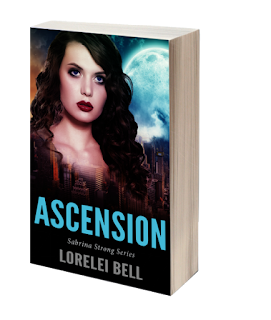
Hi, everyone, I have some great news! My first Sabrina Strong book, Ascension, is now in an audio book format.  NOW THAT I HAVE YOUR ATTE...